ChatGPT Ads vs Google Ads and Meta Ads
You already run Google Ads. Maybe Meta ads too. Then someone on the team asks whether you should add ChatGPT ads as well. The question is fair. The mistake is treating the three as one buy, or assuming a third channel will behave like the two you already know.
ChatGPT ads are a real buying option now. More than 1.2 billion people use ChatGPT each week, and over 100,000 advertisers have already run campaigns on it. Ads may appear for people on the Free and Go plans. Plans such as Plus, Pro, Business, Enterprise and Edu do not show ads, and ads are not shown to accounts identified as belonging to people under 18.
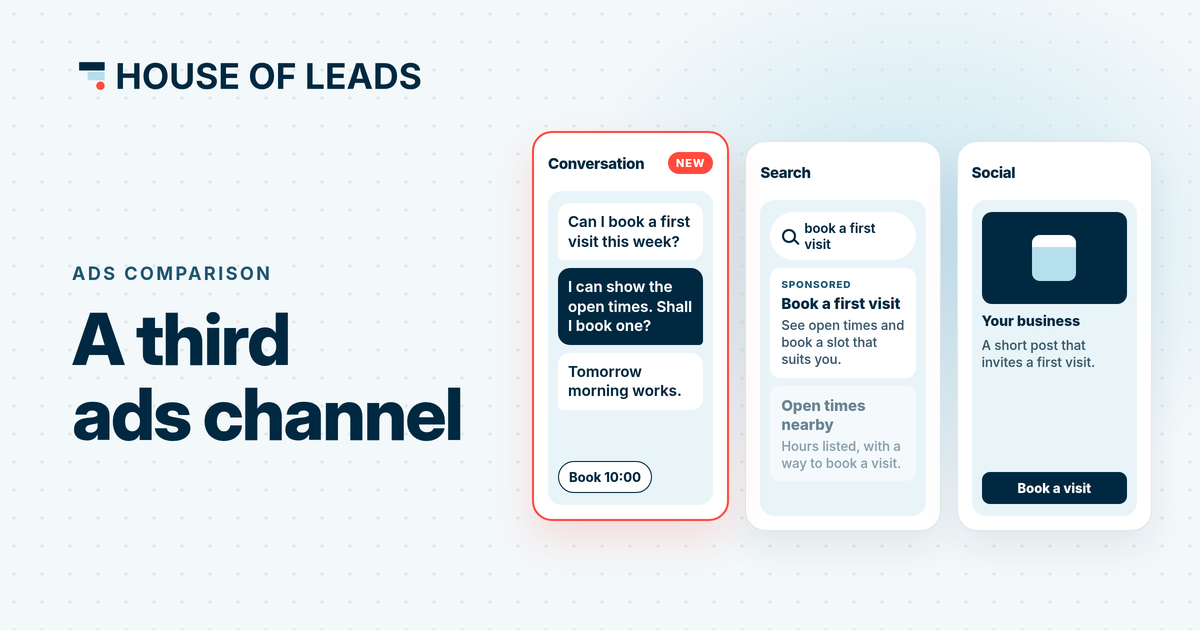
That reach is not the same as an automatic win. Google Ads still sits in search. Meta ads still sit in social feeds and stories. ChatGPT ads sit under an answer, in a conversation someone is already having. Each channel is sold on its own. You can test ChatGPT ads without changing how you buy Google or Meta, and you should.
What ChatGPT ads are, and where they appear
You may see a ChatGPT ad below a response. It is clearly marked as an ad, and it is kept separate from the answer. The ad does not change what ChatGPT says. Advertisers do not get the conversation itself, and they do not get to shape the reply.
Ads are also not eligible to appear near sensitive topics, including personal health, mental health or politics. If you sell a service that sits close to those topics, assume the placement rules will be tight, and get a clear answer before you spend.
The targeting is closer to the intent of the current chat than to a keyword match or a saved audience. Someone can ask how to choose a roofer, compare two kinds of treatment, or plan a move, and a relevant ad can appear under the answer. That is useful for a service business, because those chats often sound like the questions people ask before they call. It is also easy to overspend if you treat every chat as a hot lead.
How this differs from Google Ads and Meta ads
Google Ads is still the channel for people who type a search and click a result. You bid on the words they use, and you send them to a page. The intent is often close to a booking or a quote, especially when the search names a service and a place.
Meta ads still work further up the path, and also at retargeting. You reach people in the feed, in stories or in a form, based on interests, behaviour or a list you already have. The click is cheaper in many accounts, but the person may not have been looking for you that minute.
ChatGPT ads sit in a third place: under an answer, in a conversation. The person may be comparing options, narrowing a brief, or asking what to do next. That can be a strong moment. It is not automatically the same as a Google search for "book a consultation today", and it is not the same as a Meta campaign built around a video or a lead form.
A service business that already has the basics in place does not need to pick one and abandon the others. It needs to know which job each channel is doing, and to buy each one as its own service.
What they cost, and what early results look like
Do not invent a "typical" cost per click. Official bidding guidance and live auction prices move, and they are not a promise.
There is an official floor. For an account billed in US dollars, the official minimum daily budget is $25. Some new self service accounts can at first advertise only in their home country. Country, currency and time zone are set when the account is created, so get those right the first time.
Early performance should be read with care. In US traffic in one study of paid visits, ChatGPT ads generated $0.89 per session, compared with $2.45 for Google Search ads. Conversion was 0.37% against 1.17%. Of 87 advertisers using both channels, 97% earned less revenue per ChatGPT visit. The wider research covered nearly 10 billion sessions across 1,898 websites from June 2025 through August 2026, and the paid ads comparison used a smaller sample. It is observational, and it may miss later purchases.
Read that as a reason to test with a cap and a clear measure, not as a reason to stay away, and not as a reason to fold ChatGPT ads into a Google or Meta retainer and hope the numbers blend.
When a service business should add a third channel
Add ChatGPT ads when the first two channels already have a job, and when your team can handle the leads a third one sends.
You should be able to say, in one sentence, what a person does after they click. A booking. A form. A call back. If that path is messy on Google or Meta already, a new channel will not tidy it up.
You should also be able to see the result by channel. If all paid leads land in one pot, you will not know whether ChatGPT ads are paying for themselves. Keep the campaigns, the landing path and the CRM source separate, even if the same person later reviews all three reports.
A good first test is narrow. Pick one service, one offer, and a daily budget you can live with for a few weeks. Write the ad for the kind of question a person actually asks, not for a slogan. Then compare cost, bookings and sales quality against Google and Meta on the same offer, not against a blended average.
If the account can only advertise in your home country at first, start there. Do not build the test around reaching every market on day one.
What to refuse
Walk away from a pitch that sells Google Ads, Meta ads and ChatGPT ads as one package. They can be planned together. They should still be bought, built and measured on their own.
Be wary of anyone who quotes a single cost per click or a guaranteed return. The official minimum tells you the floor for a day's budget in dollars. It does not tell you what a click will cost in your category, or what that click will be worth.
And be wary of creative that could sit under any answer. A service business wins when the ad matches the brief in the chat: the job, the timing, the next step. If the ad could have been written for any advertiser, it will waste the click.
A simple way to start
If you already run paid ads and want a clear view of whether a third channel belongs in the mix, start with our lead generation page, then book a time. We will look at the channels you already use, what a ChatGPT ads test would need, and how to keep the buying and the measurement separate.
FAQ
What are ChatGPT ads?
They are paid placements that can appear in ChatGPT, kept separate from the answer and clearly marked as ads. They do not change what ChatGPT says. They may appear for people on the Free and Go plans, not on plans such as Plus, Pro, Business, Enterprise or Edu.
Where do ChatGPT ads appear?
They can appear below a response. There is also a test of a visual format during image generation. They are not eligible to appear near sensitive topics such as personal health, mental health or politics, and they are not shown to accounts identified as belonging to people under 18.
What is the cost of ChatGPT ads?
There is no single price for a click. For an account billed in US dollars, the official minimum daily budget is $25. Actual click costs depend on the auction, the offer and the competition. Some new accounts may at first be able to advertise only in their home country.
Are ChatGPT ads worth it for a service business?
They can be worth a controlled test if you already have a clear offer and a way to measure each channel on its own. Early US data on paid visits showed lower revenue per session and a lower conversion rate than Google Search ads, in a smaller sample inside a large observational study. Use that as a reason to test carefully, not as a final verdict.