How to Choose an AI Automation Agency in South Africa
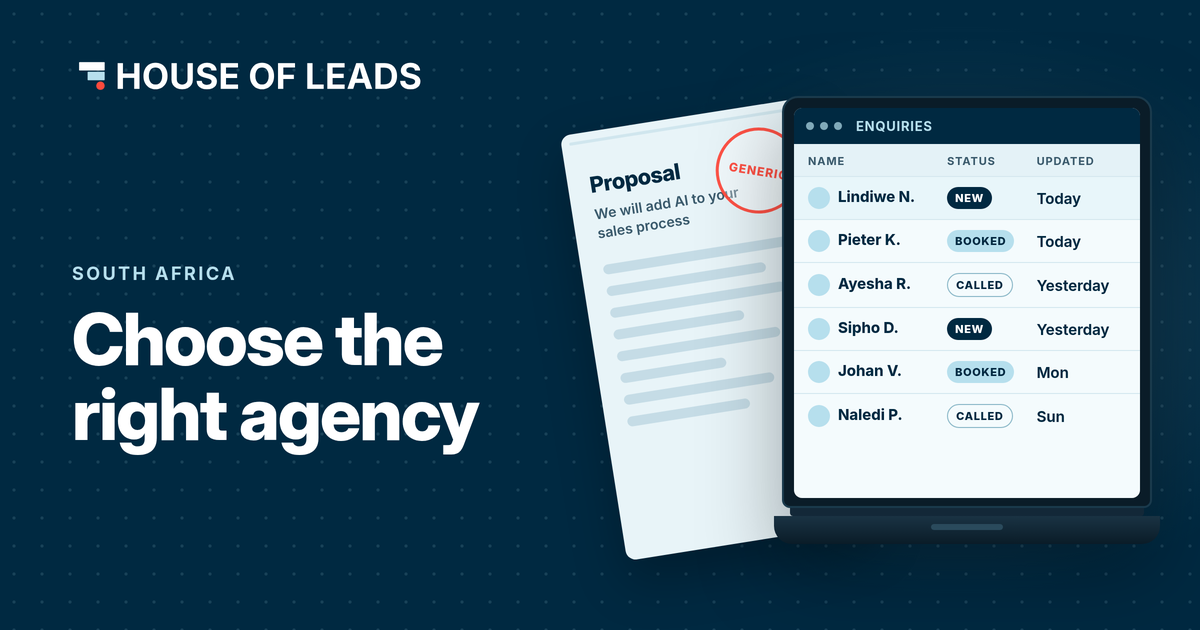
You already have a CRM. A sales team. A way of taking enquiries. Maybe ads are already running. Then the proposals start arriving, and a lot of them could have been written for any business in any industry. The same chatbot screenshot. The same line about adding AI to your sales process. Your actual tools are not mentioned once.
That is the real test. Not how slick the demo looks, but whether the agency can work with the business you already run.
Interest in AI is high in South Africa. Production use is not. In a survey of just over 100 South African technology decision makers, only about a quarter were running AI in production. Around 43% were still at the pilot stage. Among mid sized and large South African enterprises, GenAI use in large enterprises rose from 45% in 2024 to 67% a year later, but only 14% had a formal GenAI strategy for the whole company. The partner you choose decides whether a tool actually reaches daily work.
What an AI automation agency should actually do
An AI automation agency should design, build and look after the systems that help your team sell and serve customers with less manual work.
That can include a website or WhatsApp chatbot that answers common questions, qualifies the enquiry and books a time, then hands the conversation to a person when it needs one. Or an AI receptionist or voice agent that catches overflow and after hours calls. Lead scoring that tells your team which enquiries to call first. Call analysis that scores conversations against your best rep and writes the notes into the CRM. Reactivation of past customers already in your database.
You do not need all of that at once. Pick the work that closes the biggest gap, then measure it. If your team already has more enquiries than it can work properly, start there. If calls are happening but nobody can see why deals are lost, start with call analysis. If a long list of past customers is sitting still in the CRM, start with reactivation. The agency should be able to explain, in plain language, why that first build is the right one for you.
What to demand before you sign
A clear scope
Ask what will be built, what will not be built, and what done looks like. If the proposal is vague, it is not a scope. A line such as "we will add AI to your sales process" tells you nothing you can hold them to.
A real scope names the channel, the handover, the CRM fields that will be updated, and who on your team owns the conversations that the system cannot finish. It also names the timeline the agency actually controls, such as when the first system will be live. It does not name a sales result they cannot promise.
Integration with the tools you already use
Your CRM, calendar, inbox, WhatsApp and phone setup should stay at the centre. The agency should explain how new enquiries, notes, scores and bookings will land in the system your team already opens every day.
If the first suggestion is that you have to change tools before any work can start, treat that as a warning sign. An established business already has habits, records and people trained around the current setup. A serious partner works with that, or gives a clear reason why a change is required and what would be lost if you move.
A human handover
AI should take the repeatable work. A person should take the messy work.
Picture a WhatsApp chat at 20:00. The bot has answered the hours and the starting price. Then the person asks for a discount, or describes a job that does not fit a standard package. That is the moment the system should step aside, alert your team, and pass on the transcript. Ask exactly when that happens, who gets the alert, and how quickly. A system with no handover will lose good enquiries the moment a conversation goes off script.
Measurement you can see every week
Agree the numbers before the build starts. Enquiries handled. Conversations started. Bookings made. Calls scored. Old customers who replied to a reactivation offer. Those numbers should come from your own CRM and call records.
If the agency cannot tell you how the report will be built, and who will review it with you, you will not know whether the work is doing its job.
Clean data first
AI will not fix messy data. Duplicate contacts, empty fields, old lists with no consent, and notes stored in someone's head will cap what any system can do.
This is not a side issue. In a study of operations executives, only 15% of the South African respondents reported significant financial returns from AI in operations, even though 50% had already moved past the pilot stage. Data quality was named as one of the main hurdles, along with the cost of the software and a shortage of specialised talent.
A serious agency will want to tidy the CRM before it turns the automation on. That is a good sign, not a delay. If they skip this step and go straight to a demo, the build will inherit every problem you already have, then run it faster.
Agency versus doing it in house
Doing it in house makes sense when you already have someone who owns the CRM, can test changes safely, and has time to maintain the workflows after launch. An agency makes sense when you want a specialist to set the scope, build the first system, train your team, and stay on for the weekly checks.
The wrong reason to hire an agency is to set and forget. The work still needs a person on your side who can approve messages, review the odd conversation, and act on the hottest leads.
Questions to ask in the first conversation
Take these into the call:
What exactly will be live, and what is out of scope?
How does this connect to the CRM and calendar we already use?
When does the AI hand over to our team, and how are they alerted?
What will we see each week to know it is working?
What has to be cleaned in our data before you switch it on?
Who writes the scripts and who approves them?
If we already run Google Ads, Meta ads or ChatGPT ads, will this sit on top of the enquiries those channels already bring in?
That last question matters. A good automation partner can work with the leads you already get. Running the ads themselves is a different service, bought on its own. Google Ads, Meta ads and ChatGPT ads should each be decided separately. You can add or change a channel later without tying it into the automation build.
How to tell a real fit from a weak one
Slow down, or walk away, if the demo could belong to any business in any industry. Or if you hear a promise of sales results instead of a clear description of the system. Or if nobody mentions your CRM, your team or your handover.
Other warning signs: pressure to buy ads, automation and lead generation as one package. No plan for messy data. No one who can explain the build in plain language.
A real fit feels specific. They ask how your enquiries arrive, who calls them, what happens after the job, and where work gets stuck. They are comfortable telling you what not to build yet. They talk about the first system, the handover, and the weekly numbers, not about replacing your team.
A simple way to start
If you want a second pair of eyes on what to automate first, our team will walk through it with you.
Start with a consult. We look at how your sales and operations run today, where AI can take the repeatable work, and what should stay with your team. If it is a fit, book a time and we will map the first build, including the scope, the handover, and how you will measure it.
There is no need to rip out what already works. The aim is to put a useful system on top of the business you already have.
FAQ
What should I look for in an AI automation agency in South Africa?
Look for a clear scope, a plan to connect to the tools you already use, a human handover, and weekly measurement. The agency should also want to tidy your data before it turns anything on. A polished demo is not enough.
Do I need to replace my CRM to use AI automation?
No. A good build sits on top of the CRM and calendar your team already uses. If an agency's first move is to make you change systems, ask why, and what would be lost in the move.
Can the same agency also run our ads?
They might offer it, but treat it as a separate decision. Google Ads, Meta ads and ChatGPT ads are each a service on their own. Automation should help you convert the enquiries you already get. You can add or change an ads channel later without tying it into the build.
Is AI automation only for small businesses?
No. This kind of work suits established businesses that already have a sales process, a team and a flow of enquiries. The systems have more to work with when the basics are already in place.